Everyone is taking Colostrum now. No one is asking this one critical question.
Colostrum went from eyebrow-raising obscure to everywhere in a remarkably short time. Most people don’t even know they have the option to question the source.
Questions this article answers
What is colostrum, actually?
Colostrum went from a niche item known only to athletes and nutrition nerds to blowing up social media feeds and dominating store shelves. If you haven’t heard of it before, colostrum is the “first milk” every mammal produces the first few days following giving birth. All mammals make it and colostrum plays an enormous role in the nutrition of newborn mammals. It quite literally transfers the immune system and digestive function of the mother to the new born.
Colostrum is the real deal.
However, in all the excitement surrounding this nutritional boom we forgot to ask an important question: colostrum from which animal?
Since colostrum comes from all mammals, in theory, we have a lot of options. In practice though, cows are the most natural fit because, at least in America, cow production far outweighs any other domesticated mammal. But just because sourcing colostrum from cows “pragmatically fits” does not necessarily mean it is the best biological fit.
Why does the source animal matter?
If we approach the species question from a scientific point of view, goat milk is actually a better choice for your colostrum source. Goat milk is compositionally closer to human milk than cow milk and this is important because this means your body recognizes and processes it easier.
The benefits of goat milk for you are far reaching. A2 dominant, protein structure, oligosaccharide content, fat globule distribution, these are just a few of the reasons why goat milk is both easier for you to digest than cow milk. Because of its similarity to human biodynamics goat milk has been your answer if your problem is sensitivity to cow milk.

This is a conceptual positioning scale, not measured data. Goat milk sits closer to human milk in overall composition than cow milk does.
What are the benefits of goat milk?
- A protein structure that is easy-to-digest.
- A2-dominant beta-casein. Goat milk casein is naturally A2-dominant, the form many people find gentler to digest. Only a small fraction of cows have the genetic disposition to produce A2 milk.
- Far less alpha-S1 casein. Present at either zero or a fraction of cow milk levels, the protein most linked to cow dairy sensitivity.
- Packed with Medium Chain Triglycerides (MCTs). These components have a myriad of health benefits.
- Closer to human milk overall. Protein, fat, and lactose structure more closely resembles human milk.


Three compositional differences between goat milk and cow milk.
Goat vs cow colostrum: how do they compare?
| Attribute | Typical bovine colostrum | Mt. Capra goat colostrum |
|---|---|---|
| Source species | Cow | Grass-fed goat |
| Casein profile | Typically A1/A2 mixed | A2-dominant |
| Colostrum per serving | Varies by brand | 1,000 mg, guaranteed |
| Processing method | Commonly spray-dried | Refractance Window® |
| Third-party tested | Varies by brand | Yes, results published |
Before anyone chooses colostrum, they should understand the source, drying method, composition, testing, and support.

What is in the jar: two ingredients, goat colostrum and goat whey protein, and a low-temperature process. Nothing else.
How is colostrum dried, and why does it matter?
Colostrum arrives as a liquid and reaches you as a powder. Everything that happens in between is where quality is won or lost.
Mt. Capra dries its goat colostrum with patented Refractance Window® technology. Rather than using direct extremes of temperature, it relies on infra-red light and the conductivity of water to remove moisture. This process takes only around 20 minutes and protects the colostrum from the far higher temperatures found in spray drying applications. While the product is drying, it stays cool enough to rest your hand on.
The beauty of Refractance Window drying technology is that it leaves a uniform, non-porous microscopic surface on the colostrum granules increasing shelf life and protecting from oxidation.
Mt. Capra was the first company ever to offer whole food products dried using this technology.

Relative positioning of drying methods on a cold-to-hot scale. No specific temperatures are shown or implied.
Do the baby goats get theirs first?
Kids need their mother's colostrum to start their own immune systems, and they get it. Mt. Capra harvests only the surplus.


How colostrum moves from the herd to a sealed jar: kids feed first, only the surplus is collected.
What do people who switched say?
“I have been taking colostrum for months now and love the benefits. This is my first goat colostrum. I feel great, no issues with the switch. I love the 2 month supply bottle option. I will definitely be ordering more”
Jaimie T.
“Goat colostrum is easy on the stomach, because it has is Goat milk! It taste so good in my protein shakes mixed into the shake . I love the taste! 😊”
Anonymous
Across over 370 reviews of Mt. Capra's goat colostrum, more than 90% are five stars.
How do I take it?
- Best on an empty stomach.
- Loading: 2 to 4 capsules twice daily for 90 days.
- Capsules and powder are equivalent.


Loading for the first 90 days, then ongoing maintenance. Capsules and powder are equivalent.
Where does Mt. Capra's colostrum come from?
Our family-owned, sustainably-managed goat dairy located in the Pacific Northwest has been in existence since 1928. Our farm currently supports three generations who are living and working together to steward the animals, the soil, and the people who make the magic of goat milk happen.

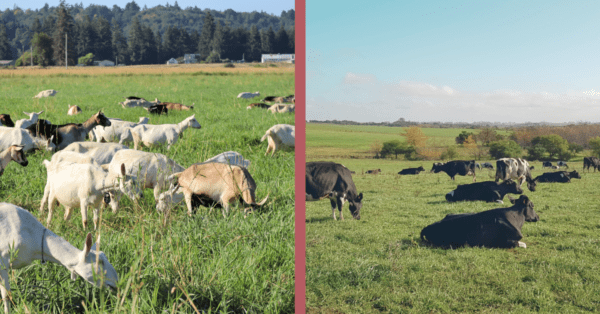
The Mt Capra goat herd roaming free on the farm pastures in Washington State.

About the author
Joe Stout, MS
Joe Stout received a Master’s of Science in Clinical Human Nutrition from the University of Bridgeport and a Bachelor’s of Science in Human Nutrition and Food Science from Washington State University. Along with running the farm, he has engaged in graduate studies of Sustainable Food Systems at Green Mountain College and is certified in Permaculture Design. Joe and his wonderful bride Elizabeth have been married for nearly 20 years and have been blessed with 10 beautiful children.