Ask most people what "milk protein" is and they'll say whey. It's the protein on every tub of powder at the gym; the one widely recognized by people from all walks of life.
Here's what usually gets left out of that conversation: whey only makes up about 20% of the protein in milk. The other 80% — the part that rarely gets its own moment — is casein.
So let's give it a moment.
What actually is casein?
Casein and whey come from the same source but behave completely differently once they hit your stomach. Whey digests fast, spiking amino acids into your bloodstream within about 30–60 minutes. Casein does the opposite: it forms a soft gel on contact with stomach acid and breaks down slowly, releasing amino acids over several hours instead of one big burst.
That slow-release property is exactly why casein shows up in overnight and sustained-release nutrition products — it feeds muscle repair while you sleep instead of spiking and clearing before your next meal.

Casein for muscle protection
When protein breaks down quickly, like whey does, your body gets a strong signal to build new muscle, but it does less to stop existing muscle from breaking down in the meantime. Casein works the opposite way. Because it digests gradually, it suppresses that breakdown process for longer, holding your body in a more protective, "maintenance" state rather than just a "building" one. It's why casein taken before bed has been shown to raise muscle protein synthesis overnight and improve your body's protein balance while you sleep.
Casein does repair work during the hours you're not doing anything else to support it. For anyone focused on preserving muscle over time, not just building it after a workout, that overnight anti-catabolic effect is where casein earns its place in the routine.
Why goat casein is a different conversation entirely
Nearly all the casein on the market — in supplements, in food manufacturing, in nearly every "casein protein" product you can name — comes from cow's milk. Ours doesn't.
Goat milk's casein behaves differently in a few specific, measurable ways. Its fat globules are smaller, giving digestive enzymes more surface area to work with. Its curd is softer and looser than cow casein's, so it breaks down more easily in digestion. And critically, goat milk casein is naturally A2-type beta-casein, not the A1 type found in most conventional cow's milk — a distinction that's been linked to fewer digestive complaints in sensitive individuals.
Put simply: it's the same protein doing the same job, but built in a way that tends to sit easier.
How we make ours
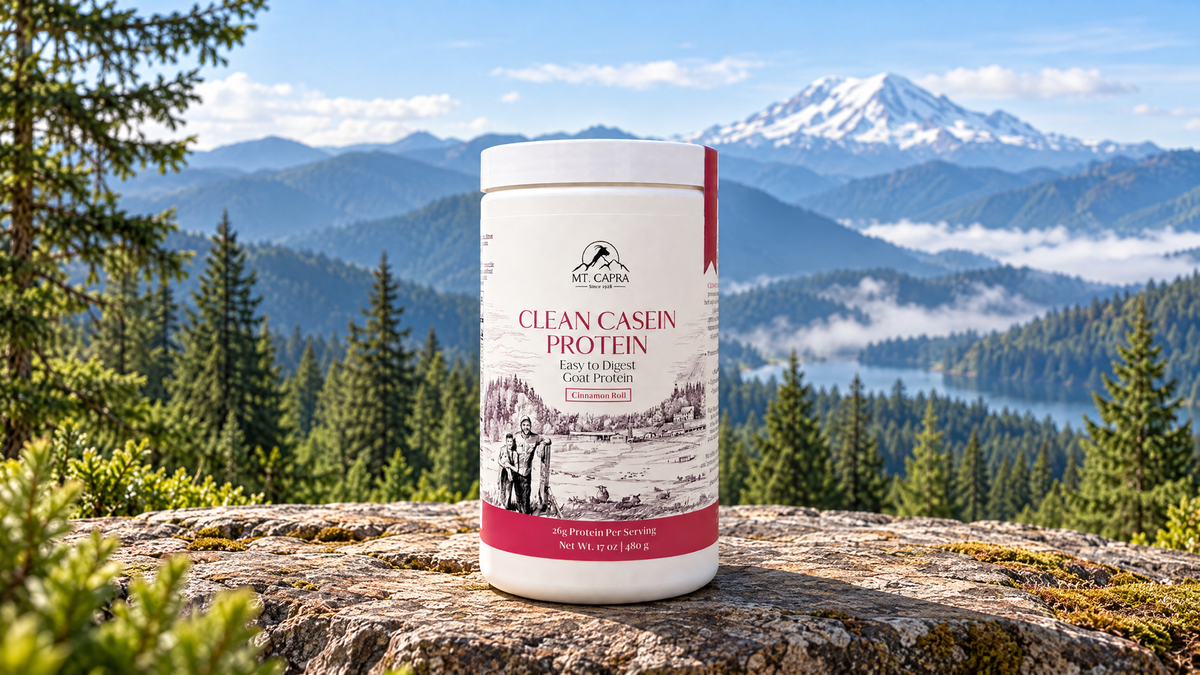
Our Clean Casein Protein is made entirely from A2 goat milk — no cow casein blended in, no shortcuts. The milk comes from grass-fed, pasture-raised goats, and we process it using our proprietary Refractance Window® drying method, a low-temperature technique that preserves the protein's structure instead of denaturing it under high heat. It's non-GMO, and free of soy, gluten, and artificial flavors or preservatives — just protein, done the way we think it should be done.
Why it matters for your lifestyle
Let's be honest. Most people aren't choosing a protein based on amino acid kinetics — they're choosing it because it needs to work with a schedule that's already full. A slow-digesting protein means you're not reaching for a snack an hour after your last shake, which matters whether you're trying to get through a long workday without a 3pm crash, or just trying to eat less mindlessly between meals.
A couple scoops before bed is the ultimate life hack. It's hard to beat something that works while you're unconscious.
Share:
Need Calcium But Can’t Do Dairy? Here's Why You Might Not Be Done with Dairy Yet
1 comment
I love the fact that Goat milk Protein helps to maintain muscle. I have Osteoperosis in the negatives. I know protein is very important, also collagen. I am suppose to do plant protein on the orders of my Naturalpath. I told her no that I was doing animal protein that it was Goat Milk. She approved. I know animal protein is best for our bones. Are there any other suggestions?