

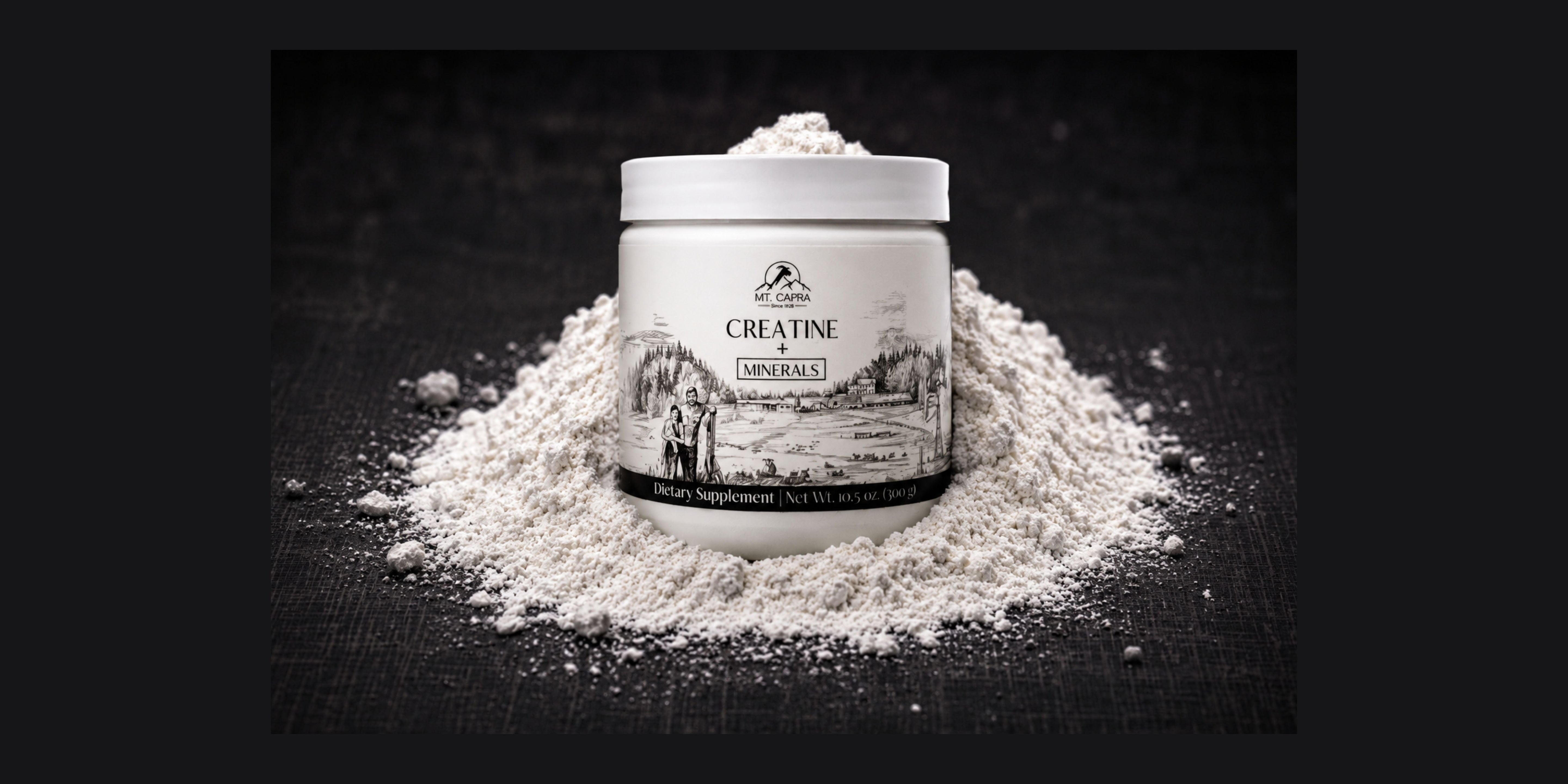
If you've spent any time around a gym, a supplement shelf, or on social media, you've heard of creatine. It's everywhere. It's also one of the most misunderstood supplements out there.
People assume it's just for bodybuilders or hard-core fitness types, that it's "unnatural," or that it'll make them puffy. None of that holds up.
Creatine is one of the most researched supplements in existence, and the research is remarkably consistent; it works, and it works for a lot more than just building muscle.
Here's what creatine actually does, who benefits from it, and how to use it well.
What Creatine Is
Creatine isn't just some lab-engineered compound — your body already makes it. Your liver, kidneys, and pancreas produce roughly 1-2 grams a day, and you get more from your diet. Protein-rich foods like red meat, seafood, and milk are good sources of creatine. Most of it gets stored in your skeletal muscle, where it's used as a quick source of energy.
Supplementing with creatine simply tops off those stores so your muscles have more fuel available when you need it most. More stored creatine = more available energy.
How It Works in Your Body
When you lift something heavy or sprint hard, your muscles need energy fast. Creatine gets converted into phosphocreatine in your muscle cells, and phosphocreatine helps regenerate ATP — the molecule your cells burn for energy during short, intense effort. More available creatine means your muscles can keep producing that energy for longer before fatigue sets in.
That's the whole mechanism. No mystery, no magic. Just more fuel in the tank for the type of effort that builds strength.
The Benefits (Backed by Research)
Strength and muscle growth. This is the benefit creatine is best known for, and it's the most studied. Creatine helps you push more volume in training, which over time translates into more strength and lean muscle, particularly for short, high-intensity efforts like lifting or sprinting.
Faster recovery. Creatine appears to activate satellite cells, which help repair the micro-tears in muscle tissue that happen during training. That can mean less soreness and a quicker turnaround between hard sessions.
Brain and bone health. This is the part that surprises people. At higher doses (typically 7-20 grams daily), creatine has shown potential cognitive benefits — memory, reasoning, and neuroprotective effects, particularly in older adults. Dr. Louisa Nicola, a neurophysiologist specializing in brain health and Alzheimer's prevention, has been one of the prominent voices helping shift the conversation around creatine beyond muscle and athletic performance. She points out that it plays a role in cellular energy production throughout the body, including the brain, which has an enormous demand for energy. Emerging research suggests that creatine supplementation may support cognitive performance, particularly during periods of metabolic stress such as sleep deprivation or mental fatigue.
Better hydration, less cramping. Because creatine draws water into muscle cells, it can help with cellular hydration and may reduce cramping risk during intense or prolonged effort.
Who Should Take Creatine
Short answer: more people than you'd think. Dr. Nicola believes that everyone should take it. Creatine isn't just for competitive lifters or people trying to bulk up. Research has found women may see even larger relative performance gains from creatine than men — one analysis found roughly a 15% improvement in women compared to about 6% in men. It's also being studied for benefits in older adults well outside the context of athletic performance. If you train, if you're trying to maintain muscle and cognitive sharpness as you age, or if you just want more consistent energy in daily life or through your workouts, creatine is worth considering.
How Much to Take (and When)
There's a loading phase protocol that suggests 20 grams per day, split into smaller doses, for about a week. This saturates your muscle stores fast, but can also result in feeling puffy. A maintenance dose of 3-5 grams per day, taken consistently, is the simplest approach and the one most people stick with long term. A higher dose protocol of 7-10+ grams per day is the range studied for the brain and bone benefits mentioned above.
Timing matters less than consistency. Whether you take it before, during, or after a workout, or just with a meal, the key is taking it every day so your muscle stores stay topped off. It can even be mixed into hot beverages without degrading.
Most people notice a difference within 2-4 weeks of consistent use.
Why We Put Minerals in Ours
Most creatine on the market is just creatine monohydrate, and that's a perfectly effective, well-studied form. We have a plain option as well. But since creatine's job is partly about cellular hydration, we thought the mineral and electrolyte content in our goat whey was a natural complement rather than an accident of convenience.
Our Creatine + Minerals blends creatine monohydrate with goat whey mineral concentrate — naturally occurring minerals and electrolytes that support absorption and hydration alongside the creatine itself. No fillers, no flavors, nothing added to take up extra space. Just creatine and the minerals that help your body actually use it.
What Our Customers Are Saying
"I have been taking this for 5 months. Along with a healthy lifestyle. I can honestly say that I have better muscle definition. And more energy. I. have put this in a monthly subscription. I don't want to run low or run out."
-Nancy Bushka, verified user
That's the pattern we hear most; not a dramatic overnight change, but steady, visible progress over months of consistent use — which lines up with exactly how creatine is supposed to work.
Ready to Try It
Creatine is cheap, well-studied, and useful for far more people than the gym-bro stereotype. If you're already training consistently and want to get more out of it, or if you're curious about the cognitive and recovery benefits, it's one of the easiest additions to make to your routine.

Shop Mt. Capra Creatine and Creatine + Minerals
Share:
The Isometric Challenge: Why Holding Still Might Be the Strongest Move You Make